








Google Workspace is constantly evolving. Each week brings its share of new features, adjustments and improvements to Gmail, Drive, Docs, Sheets, Meet or even Calendar.
The problem isn't the lack of information. It's elsewhere.
For most users, keeping up with these developments requires time, consistency, and the ability to sort the essential from the superfluous.
In reality, this monitoring is often put aside. Too long, too dispersed, too technical, or simply incompatible with the rhythm of everyday life.
It is precisely this problem that the Google Workspace news digest integrated into GSkills solves.
Google Workspace monitoring: an underestimated issue
The official Google sources are numerous and of high quality. Product blogs, update centers, announcements by application, technical notes…

But reading them requires an effort that few users can provide continuously.
Result:
- new features are discovered late, sometimes by chance,
- some useful features go completely unnoticed,
- the gap widens between what the tools allow and what is actually used.
Even for IT profiles or managers, maintaining regular monitoring becomes a difficult exercise. For business users, monitoring is simply not a priority.
Information that must adapt to uses, not the other way around
Not all Google Workspace users work the same way. A Gmail user does not expect the same information as an advanced Google Sheets user or a collaborator who is very present in videoconferences on Google Meet.
However, traditional channels disseminate information globally, without distinction. Too much information kills information.
Useful monitoring must meet three simple principles:
- be understandable regardless of the user's level,
- be relevant to the tools actually used,
- remain deliberately limited in volume.
The Google Workspace news digest in GSkills
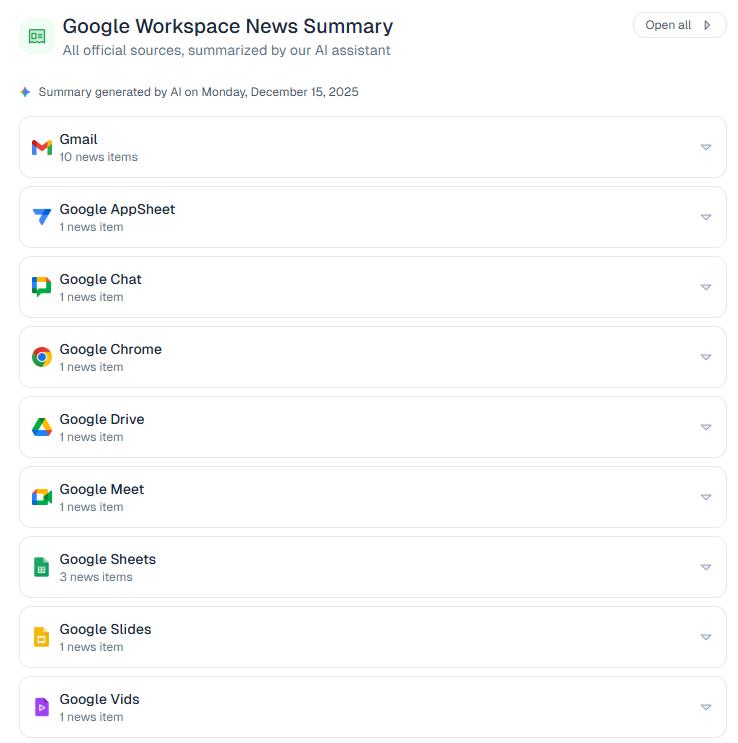
The Google Workspace news digest has been designed to transform complex monitoring into directly usable information.
Each week:
- the new features from official Google sources are analyzed,
- an AI extracts the essentials, without unnecessary jargon,
- the information is classified by application of the Google Workspace suite.
The user thus accesses a clear and structured view of recent developments, application by application, without having to navigate between several sources.
It is not a continuous news feed, but a deliberately controlled summary, designed to be read quickly.
Less information, but of better quality
The goal is not to show everything, but to show what really matters.
The summary favors:
- new features that have a concrete impact on uses,
- changes that improve daily life,
- developments that deserve to be known, even without technical expertise.
Each piece of information answers a simple question: what does this change for me in my use of Google Workspace?
This approach allows you to stay informed without cognitive overload, while maintaining reliable and contextualized information.

A feature accessible to everyone, by default
The Google Workspace news summary is integrated directly into the GSkills homepage.
It does not require:
- any configuration,
- no specific action on the part of the user,
- no additional cost.
All GSkills users have access to it automatically. Monitoring thus becomes a natural reflex, integrated into the daily experience, and not an additional task to plan.
A natural entry point to skills development
Being informed is one thing. Understanding and adopting is another.
By highlighting relevant new features, the summary plays a key role:
- it makes it possible to identify what deserves to be explored,
- it facilitates awareness of available developments,
- it creates a natural link with educational content and concrete uses.
A new feature that is understood is much more easily adopted.
Monitoring no longer becomes an end in itself, but a starting point towards a more efficient use of tools.
Stay up to date, effortlessly with GSkills
With the Google Workspace news summary, GSkills responds to a simple but essential need: to allow each user to stay informed, without spending unnecessary time on it.
Monitoring becomes clear, synthetic and accessible, regardless of the position held. The information is there, at the right time, at the right level, integrated directly into the work environment.