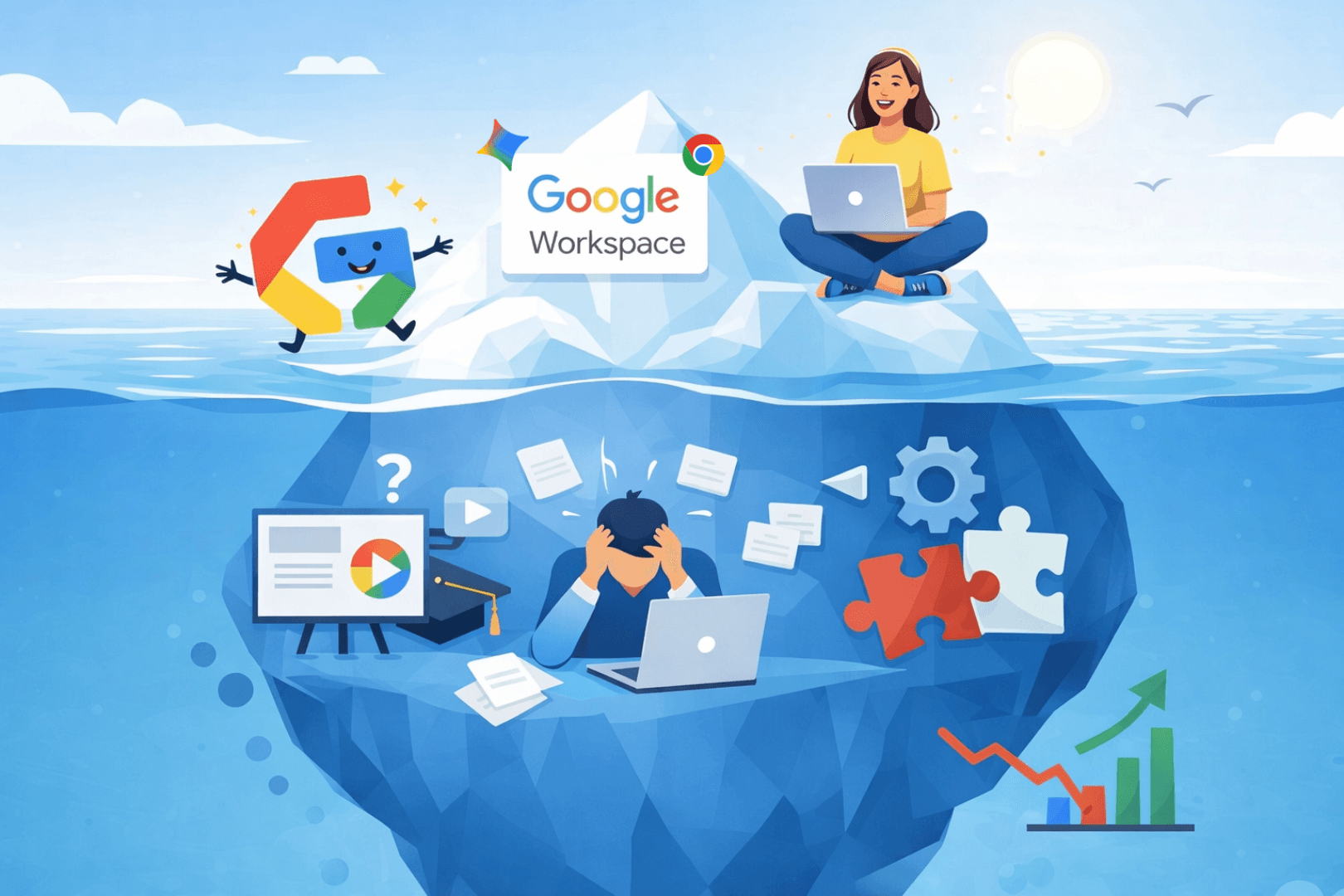






A collaborator arrives in a company equipped with Google Workspace. The tools are available. Gemini is enabled. The licenses are deployed.
A few weeks later, however, the uses remain limited. Drive is used as a simple storage space. Gmail is used to send emails. The advanced features are little used.
The problem is not technical. It is behavioral.
How to create regularity, commitment and continuous progress?
The answer lies in one word: gamification.
Why gamification really changes engagement
Skill development is based on three pillars:
- Motivation
- Repetition
- Feedback
Without motivation, we don't start. Without repetition, we forget. Without feedback, we don't progress.
Gamification acts precisely on these three levers.
It transforms content into an experience. It makes progress visible. It rewards effort.
A badge obtained, a level crossed or a ranking consulted creates a dynamic. Learning becomes active.
But gamification is not a simple point system. It must support a clear pedagogical strategy.
When the game actually structures learning
Duolingo

Duolingo is based on:
- Daily micro-lessons
- A series of consecutive days
- Weekly leagues
- Simple and measurable objectives
Regularity becomes a habit. Progress is visible. The user always knows what to do next.
Duolingo's success is not only due to its content, but to its engagement mechanics.
Salesforce and Trailhead

Salesforce has built Trailhead as a true gamified skill development platform.
It includes:
- Short and progressive modules
- Public badges
- Levels to unlock
- Points accumulated
- Rankings
Badges are visible on the profile and can be valued externally. Progress becomes a signal of competence.
What is interesting here is not the playful aspect. It is professional recognition.
Gamification becomes a tool for credibility.
The different types of gamification
Not all mechanics produce the same effects.
1. Structured progression
- Levels
- Guided tours
- Progressive unlocking
It gives a clear trajectory.
2. Rewards
- Points
- Badges
- Internal certifications
They materialize the effort.
3. Social dynamics
- Rankings
- Collective challenges
- Leagues
It creates energy and visibility.
4. The ritual
- Daily goal
- Series of days
- Reminders
It transforms learning into a habit.
5. Immediate feedback
- Instant quiz
- Explanation of correction
- Redirection to the correct resource
It transforms error into learning.
Gamification at the heart of GSkills
GSkills functions as an LMS dedicated to upskilling on Google Workspace, Gemini, and ChromeOS.
Gamification is integrated there as a lever of engagement and not as simple decoration.
The platform offers:
- A points system
- Badges
- A leaderboard
- Structured paths
- Quizzes with immediate score
The global data shows an interesting phenomenon: users who consult the ranking are significantly more active than those who do not.

Gamification acts as an engagement multiplier.
A strategic advantage: configurable gamification
Not all companies have the same culture.
Some appreciate visible competition. Others prefer to value individual progress.
In GSkills, several mechanics can be activated or deactivated depending on the instance:
- Ranking
- Badges
- Mandatory courses
- Recommended pace
This flexibility is essential.
Gamification is not imposed. It adapts to the context of the organization.
Stimulate engagement, but also prove progression
The challenge is not limited to animating.
The real question is: are skills really progressing?
GSkills allows you to cross:
- The courses followed
- The validated quizzes
- The declared skills
- Usage data from the Google Admin console
Gamification stimulates action. The data confirms adoption.
Why gamification is becoming essential
Tools are constantly evolving. Uses must follow.
A one-off program is no longer enough. Skills development must be continuous.
Gamification provides:
- Regularity
- Visibility
- Motivation
- Recognition
Well designed, it transforms a learning platform into an adoption engine.
Conclusion
The question is no longer whether to gamify.
The real question is: how to do it intelligently?
Effective gamification:
- Respects the company culture
- Encourages without infantilizing
- Values progress
- Relies on real data
It is this approach that allows GSkills to sustainably support skills development and accelerate the adoption of Google tools in the company.
Gamification is not a fad. It has become a strategic lever.