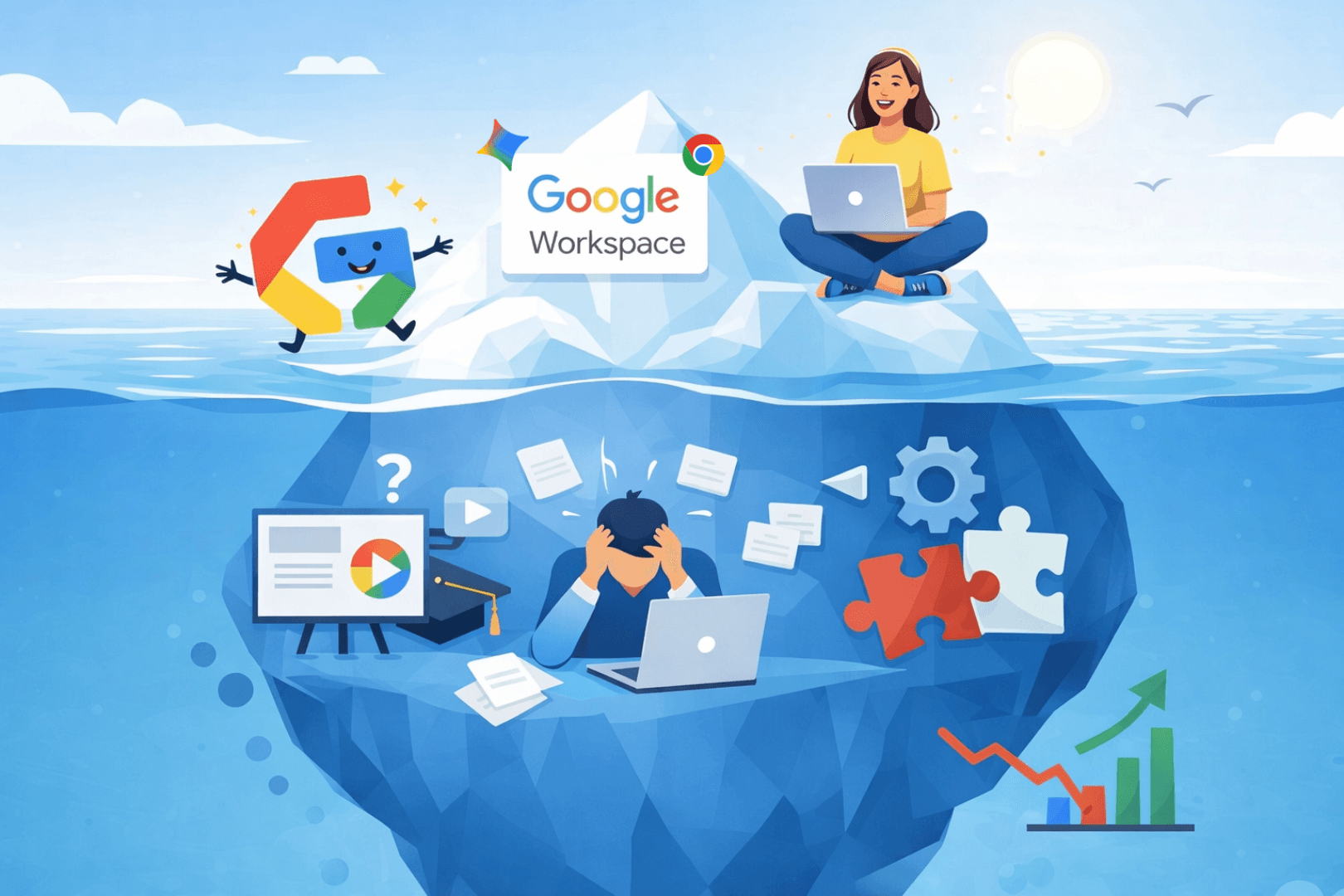










In many companies, the migration to Google Workspace goes well... technically.
Accounts are created. The tools are accessible. The licenses are active.
And yet, a few weeks later, the same questions come back:
"How do I do this in Sheets?" "Is it normal that it doesn't work like in Outlook?" "Is there a bug on Drive?"
In reality, there is no bug. There is a moment of adaptation.
And this is precisely where the ambassadors make all the difference.
The observation: a tool is not adopted alone
From the first version of GSkills, an observation was made.
Having internal product referents is essential to guarantee the success of a Google Workspace deployment.
We can offer educational content. We can structure courses. We can measure adoption.
But nothing replaces an identified, accessible collaborator, already convinced and a daily user of a tool.
A champion is not a theoretical expert. It is a collaborator who uses Gmail, Sheets, Drive, Gemini or ChromeOS on a daily basis... and who wants to help others progress.
Sometimes, he already knew the tool in his personal life. Sometimes, he had a click after the migration.
In any case, he becomes a landmark.
The champions program in GSkills
In each GSkills instance, a dedicated section allows you to clearly identify these ambassadors.

Specifically, a collaborator can:
- filter ambassadors by tool
- search for a name or skill via a search engine
- see the list of referents with name, first name, photo, email and mastered software
The objective is simple: allow everyone to quickly find the right person to help them.
This program covers all Google Workspace tools, but also Gemini and ChromeOS. The ambition is to support the entire Google suite, not just an isolated application.
Today, this section is informative. It connects. It makes it visible. And that already changes a lot.
Relieve IT and streamline adoption
During a migration, a classic phenomenon appears.
A user encounters a difficulty on Google Sheets. Accustomed to Microsoft Excel, he does not find a reflex.
Without an internal benchmark, he opens an IT ticket.
The problem is not technical. It is related to use.
The Champions program avoids this shortcut.
Instead of immediately categorizing a blockage as a malfunction, the employee knows who to turn to. He can ask an identified referent for advice.
Result:
- IT teams are less solicited for questions of use
- migration managers are less saturated
- users get a quick and contextualized response
We move from a support-centered model to a structured mutual aid model.
A collective dynamic that changes everything
The impact is not limited to resolving specific issues.
When internal experts are visible:
- employees feel less alone in the face of change
- ambassadors feel valued
- a positive dynamic is put in place
A virtuous circle appears.
The champions become models of usage. Other employees dare to ask questions more easily. Adoption becomes collective, no longer individual.
It is no longer just a competence building driven by a tool. It is a dynamic carried by people.
A strategic pillar, not a simple directory
In GSkills, the champion program is not an ancillary module. It is a pillar in its own right of the adoption strategy.
GSkills structures educational content, courses, quizzes, gamification. The ambassador program complements this foundation with a human lever.
Where many platforms are limited to a catalog of courses, the champion program creates a link between the platform and the reality on the ground.
Adoption no longer relies solely on content. It also relies on faces, first names, colleagues.
A section in evolution
Today, the ambassadors section is informative.
Tomorrow, it could go further. For example with specific badges per tool or additional recognition mechanisms.
This evolution is part of the continuous reflection around GSkills. But already, in its current form, the program profoundly changes the adoption experience.
Valuing those who help, supporting those who learn
The champion program has a simple ambition:
To value the ambassadors and their help, while helping the entire team that has just been migrated to Google Workspace or that is embarking on the Google ecosystem.
Adoption is not decreed. It is accompanied.
And sometimes, what really makes the difference is not an additional feature.
It's an identified colleague, ready to say: « Come, I'll show you. »
Conclusion
A successful migration is not only measured in activated accounts. It is measured in real, fluid, confident uses.
The champions program transforms adoption into a collective dynamic. It structures mutual aid. It values internal experts. It relieves IT. It accelerates the rise in competence.
And this is precisely where the ambassadors make all the difference.