




Deploying Google Workspace does not guarantee its adoption.
Many organizations find, a few months after a migration, that usage remains heterogeneous. Some employees fully exploit the Google Workspace ecosystem, while others continue to work as before, sometimes even on Microsoft tools in parallel. Google Drive becomes a simple storage space, good collaborative practices are not homogeneous and key features remain unknown.
The subject is not technical. It is cultural and organizational.
This is precisely where Change Management makes perfect sense. Not as a series of isolated actions, but as a structured approach aimed at creating a common base of skills and practices to guarantee digital equality between all employees.
Sanctuarizing a shared starting point
A French company, a leader in its sector, recently chose to introduce a mandatory course for 100% of employees, including management, with a deadline set for March 21, 2026. The objective is to guarantee everyone the same level of ease with the fundamentals of digital collaboration: Gmail, Drive, Meet, Chat, Calendar and Chrome
From obligation to membership: a gain in daily comfort
If the framework is strict — quiz validation required and new passage possible after 24 hours in case of failure — the issue goes beyond simple control. The message is oriented towards personal efficiency.
Beyond the constraint, this course is designed to reduce the "irritants" of everyday life: for example, ending up with the chaos of document versions or the infobesity of endless email loops.
The idea is to structure an appropriation time (10 minutes per day) that many would never have taken spontaneously, to finally gain quality time on their critical missions.
The manager: more than a pilot, a model
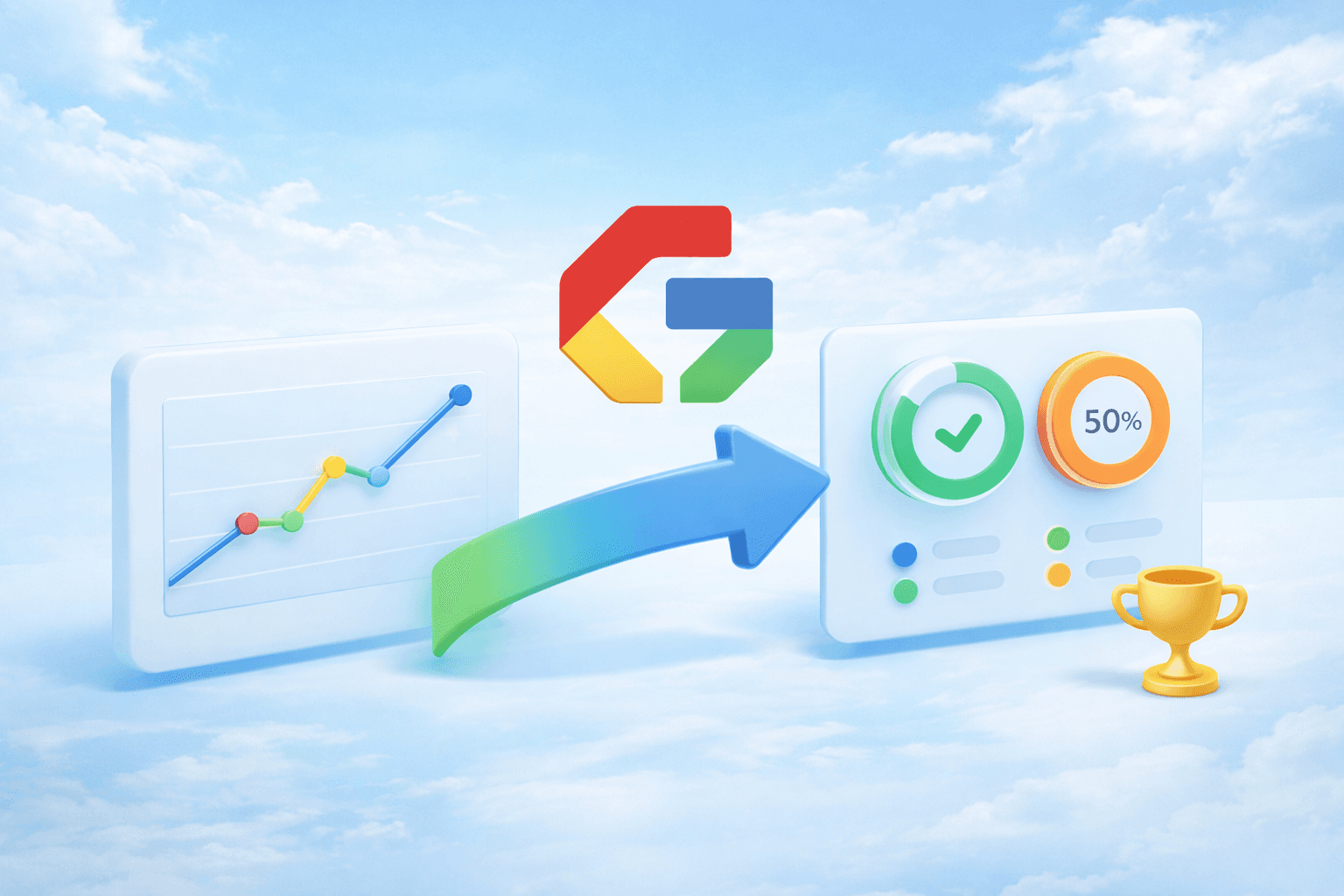
The project is piloted by data, allowing comparison of completion rates between the different "houses" (internal entities). This visibility allows managers to identify specific support needs and remove objective obstacles.
However, the manager's role does not stop at monitoring statistics. For this foundation to become a true culture, managers must embody these new rituals. By using Drive sharing features themselves or Chat spaces for team coordination, they transform a quiz score into a living and exemplary practice.
Build the foundations before activating AI
This foundation is only a first step. Once the fundamentals have been validated, the company will deploy courses on production tools (Sheets, Docs, Slides) and then on generative AI with Gemini. The logic is progressive: before introducing AI, it is essential that the collaborative bases are mastered by everyone so as not to leave anyone behind.
After March 21: anchoring change in the long term
The deadline of March 21 marks the end of a stage, but not that of the transformation. A successful change depends on duration. To prevent good practices from evaporating, the company relies on:
- Continuous support: an integrated knowledge base and an internal discussion space remain accessible to deepen the subjects.
- Anchoring habits: the success of the project will be measured, three months after the deadline, by the generalization of collaborative uses in cross-functional projects.
In summary, structuring adoption is not a luxury, it is a strategic investment to ensure that technological innovation really benefits collective intelligence.